

For years, common veterinary advice has been to spay or neuter your pets as soon as possible, preferably before they even reach puberty, in order to avoid unwanted litters. However, with large breeds like Anatolians, it is recommended to wait until at least two or even three years old in order to ensure proper bone growth and joint formation. This means that owners of female Anatolians will have at least two and possibly more “seasons” or heat cycles to manage before spaying.
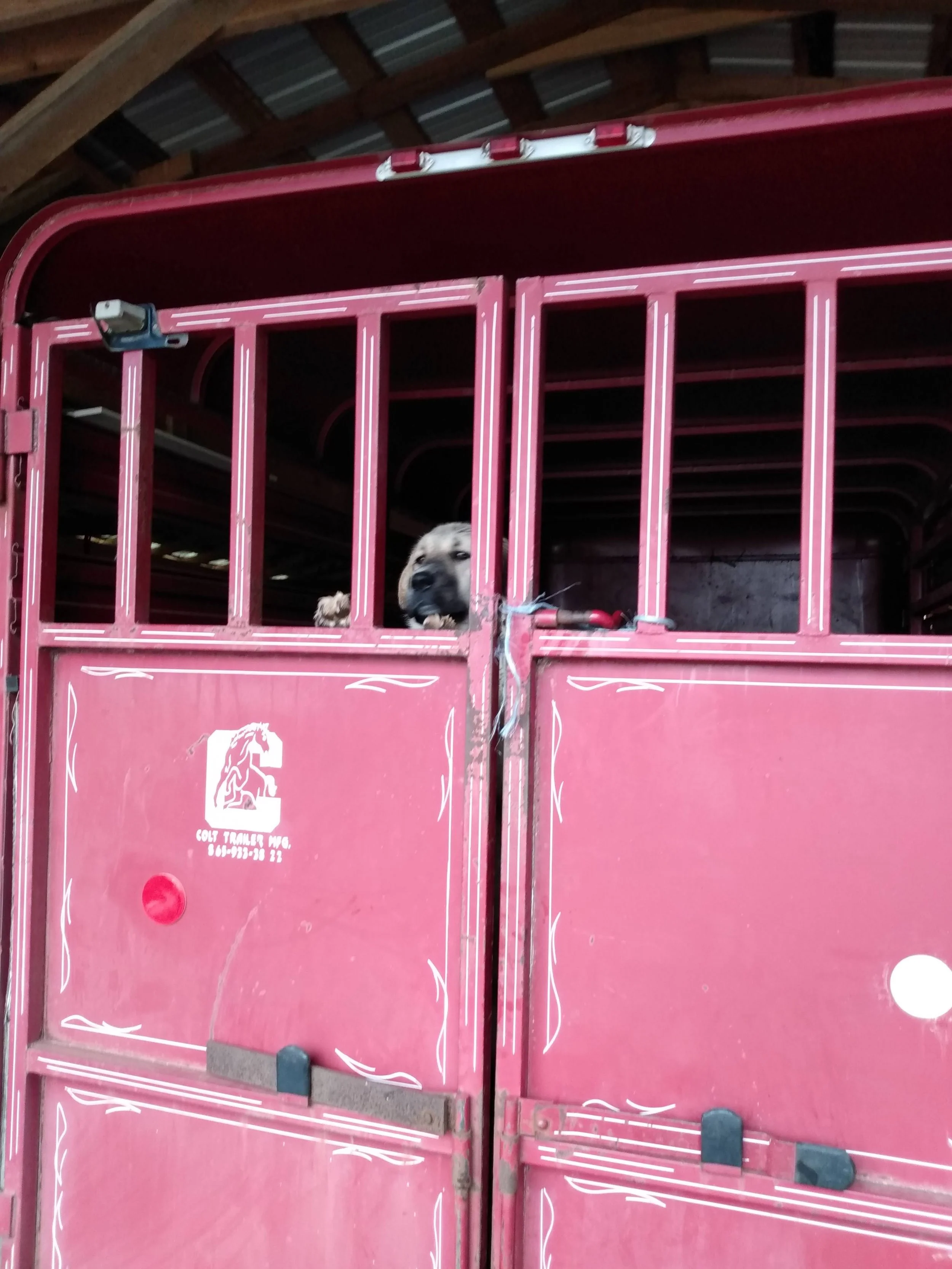
Dolly wondering why she’s in doggy jail.
We’d always had our dogs fixed at young ages, because that’s what we’d been told was best. When we got our first female Anatolian, Dolly, the thought of dealing with a heat cycle was daunting, especially after reading so many horror stories on the internet! I was prepared, though. I knew what I was looking for, and once Dolly started showing signs of being in heat, she was locked up tighter than Alcatraz for the next four weeks. Now, with several seasons under our belt, we’re not nearly as paranoid. Don’t get me wrong, it’s still a difficult 3-4 weeks for the dogs and for us, but it’s manageable. Fortunately, Anatolian heat cycles are usually 8-12 months apart, so it’s an infrequent inconvenience.
Female Anatolians will experience their first season somewhere between 8 and 14 months. Dolly was a few days shy of nine months old for her fist heat cycle. Her daughters that we’ve kept, Izzy and Sissy, are 10 months old today and have yet to show any signs of going into heat. (UPDATE: They and their littermates had their first cycles at 12-14 months of age.) This is actually a good thing, as early puberty and more frequent cycles put more stress on both the dogs and the owners. I’m pleased that we’ve been able to improve this trait in Dolly’s daughters.
The first signs of heat that an owner might notice is a shift in personality. Your girl may get moody, cranky, possessive, aggressive towards other dogs, or clingy. She may be extra hungry, or have no interest in food. Have you ever had to deal with a teenage girl having her period? If you have, you’ll be prepared for your dog’s first heat cycle. Your dog is PMSing, big time, and she’s going to let you and any other dogs you have know that she’s in a mood. Even if you’ve never before had issues with food aggression, resource guarding, or other difficult behaviors, it’s often triggered at this time. The first heat cycle tends to be the worst in terms of moodiness and behavior changes. Like humans, your dog will often appreciate extra comfort, attention, massages, and a heated mat at this time. Skip the chocolate, though!
The next thing you’ll notice is swelling of your female’s vulva and bloody discharge. Some dogs bleed more than others. If your girl is inside, you may want to consider diapers or confining her to an area that’s easy to clean. There’s not a lot of blood, but we all know how difficult it can be to get blood out of the couch or carpet. She’ll usually spend a lot of time licking and cleaning herself, sometimes obsessively. She may also start urinating much more frequently. The worst “PMS” symptoms are during this period, which is known as proestrus, and it can last anywhere from 3 to 12 days. For Dolly, this period lasts 10-11 days. During this time, your girl will have no interest in mating. Males may try to mount, but she’ll move away. Females are usually not fertile during this period.
During proestrus, we are fairly relaxed about keeping Dolly confined until around day six. She’s not interested in mating and is highly unlikely to be fertile. We’ll confine her overnight or if we aren’t around for more than a few hours, but we otherwise let her be. If our male, Kenny, tries to mount her, she’ll tell him to bug off, and we’ve never had an issue with neighbor dogs coming on our property to get to her.
Starting around day six, we will begin to confine Kenny if Dolly is out, and vice versa. I’ll also begin to pay a lot more attention to their behavior towards each other. What I’m watching for is any sign of “flirting”, which will signal that she’s moving into the fertile “estrus” stage. Again, this typically doesn’t happen for Dolly until at least day 10, but I don’t want to be caught off guard! We will be more cautious with Izzy and Sissy this first time around and begin confinement around day four as we don’t yet know what their cycles will look like. (We also don’t want an accidental father-daughter mating!)
Having a male dog around, whether fixed or intact, is one of the easiest ways to tell if your female is moving into the estrus stage. She will get more playful, back into him, “flag” her tail to the side, and allow mounting. If you don’t have a male dog, she may engage in this flirty behavior with her humans. The other tell tale sign that she is moving from proestrus to estrus is when the bloody discharge changes to a more clear, straw colored discharge.
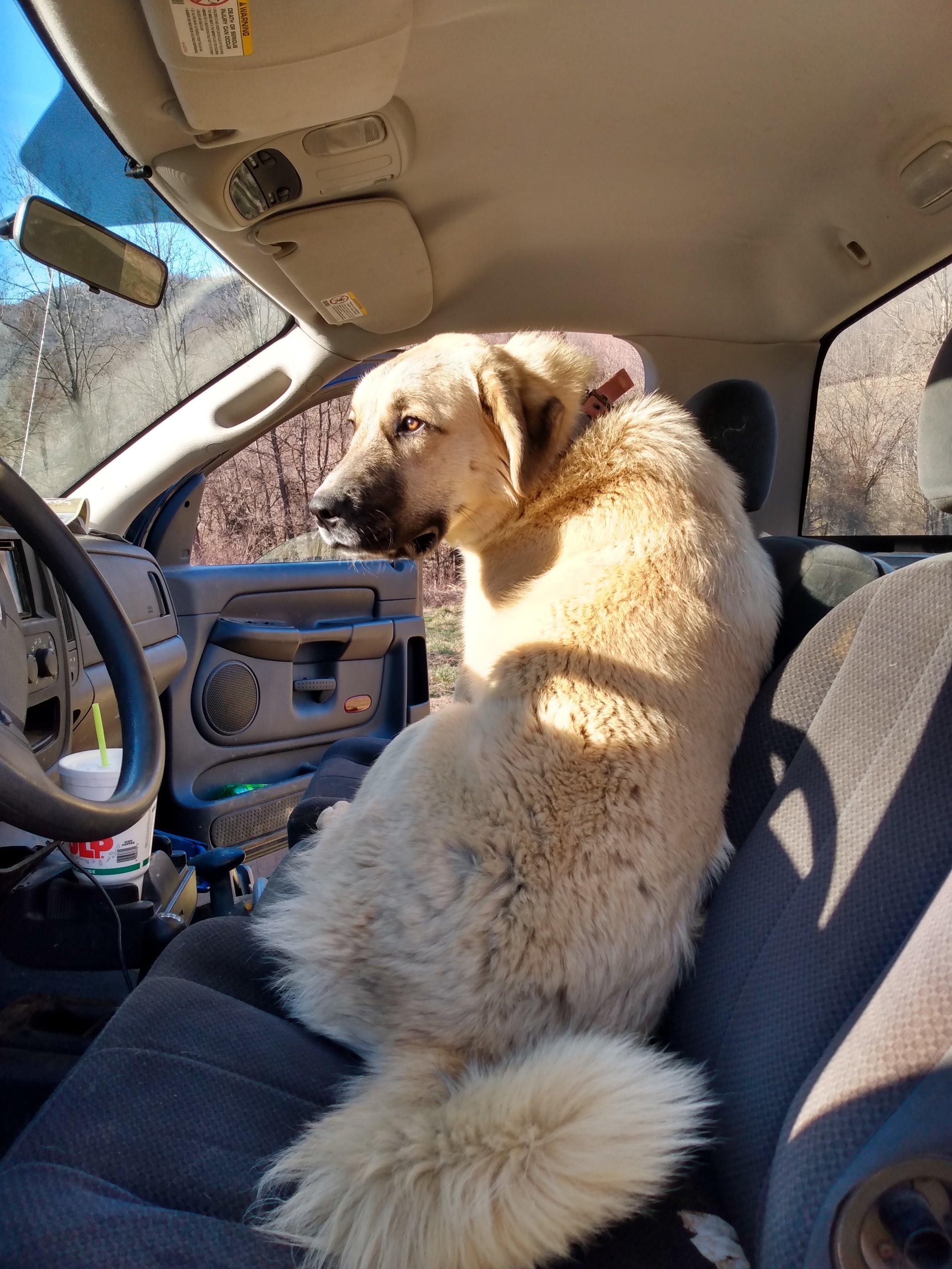
Under direct supervision at all times during estrus!
From day seven onward, we’ll occasionally allow them out together, but leashed. Once Dolly indicates that she’ll allow Kenny to mount, we keep them apart and full lockdown procedures are put in place. Kenny must be kenneled before Dolly is allowed out, and vice versa. Dolly must be kenneled, leashed, in a vehicle, confined in the barn, or under our direct supervision in some way at all times. If we’re not around, she’s kenneled, and Kenny is too. Their kennels are chain link, and while he hasn’t yet been able to mate her through the fencing, we prefer not to take that chance. Before we had multiple kennels, we used our livestock trailer, our barn, an enclosed chicken run, electric net fencing, and whatever else we had available for confinement. Ovulation will typically occur a day or more into the estrus cycle, and once it does, male dogs will start to go crazy - whining, digging, and fighting you to get at your female. It helps to be able to confine them far away from each other if possible. Stray dogs, neighboring dogs, and coyotes may become an issue at this time, which is why confining your female unless she’s under your direct supervision is important even if you don’t have an intact male. She may even decide to go looking for a boyfriend, so be on your guard against escapes. It’s going to be a long several days!
For Dolly, estrus only lasts around five days, but the estrus phase can last up to 10 days. After five days, we’ll again try leashed introductions. If estrus is over, she will tell Kenny to back off when he tries to mount. At this point, we will still keep them separated for another two days to be sure she’s no longer fertile, because Kenny will continuously try to mount and eventually wear her down. Even after those extra two days, he will still try to mount. For the sake of science we allowed them to be together two days after she first refused his attention, and while he mounted, no pregnancy occurred. Just be aware that a female could still be fertile even when she no longer shows interest. If you don’t have a male dog to test whether estrus is over for your female, assume she’s fertile until around day 21 after she first began bleeding, and continue to confine her if you’re not around.
To save you the awkward search history, I’ve already researched it and found out that male dogs usually do not ejaculate immediately, so if a male mounts your female, you should be safe if you pull him off within a minute. However, never ever separate dogs that have “tied” as you will damage both of them (there are shots or pills that can be given that day or the day after to terminate any potential pregnancies if necessary). When dogs tie, the male will change position after ejaculation so that they are still locked by their genitals, but facing opposite directions, and this can last for up to half an hour. Again, don’t ever separate them during this period.
Once estrus is over, your female will go into anestrus (unless she’s pregnant!). Over the next few weeks, her swelling will decrease until her vulva is back to normal size. There’s nothing more to worry about until next time, which should be somewhere from eight to twelve months later. Dolly’s heat cycles are every 8.5 months, but I’m hoping her daughters’ will be farther apart. Just be aware that like with humans, their first few cycles can be irregular, so it is possible your female could have her next cycle much more quickly than normal. Additionally, as we’ve discovered now that we have multiple females, they will sync up (more or less), which could affect interval spacing as they sync.

Freedom at last!
And there you have it! You’ve dreaded it, and it felt like it would never end while you were in the thick of it, but now that it’s over, you realize it wasn’t so bad and you can handle this a couple more times until your girl is old enough to be spayed. And maybe, like us, you’ll even decide not to spay her at all. Many veterinarians now recommend not spaying or neutering at all (for owners who feel capable of managing their female’s heat cycles). Just like when we remove a human’s sex organs, removing a dog’s sex organs takes away necessary hormones and leads to health issues and changes in personality. It’s a common misconception that getting a dog fixed will reduce behavior problems; it can actually increase behavior problems instead. Another option is to choose a surgery more similar to the birth control methods we use for humans - tubal ligation for a female or a vasectomy for a male rather than full removal of sex organs. These less drastic methods of doggie birth control are significantly more expensive, however, so it’s a trade off (if you can even find a veterinarian to perform them).
I am still undecided on whether we will ever get any of our Anatolians fixed. We will most likely choose not to spay Dolly even though we only intend to have one or two more litters with her. Anesthesia is more risky for large breed dogs, and she didn’t have the best reaction to it when she had to be put under for the hip health test recommended for breeding. I am leaning towards getting a vasectomy for Kenny somewhere down the line, if we can find a vet who will do it (and we can afford it!), as that will be the easiest way to ensure he doesn’t breed his daughters. We will be looking for another male in a year or two to continue our breeding program. But that’s years away and who knows what might happen in the meantime. I have my plans, and God has His!
Feel free to reach out via text or email if you have any questions about managing your female’s heat cycle, or any other questions at all!
And look for more blog posts soon!