

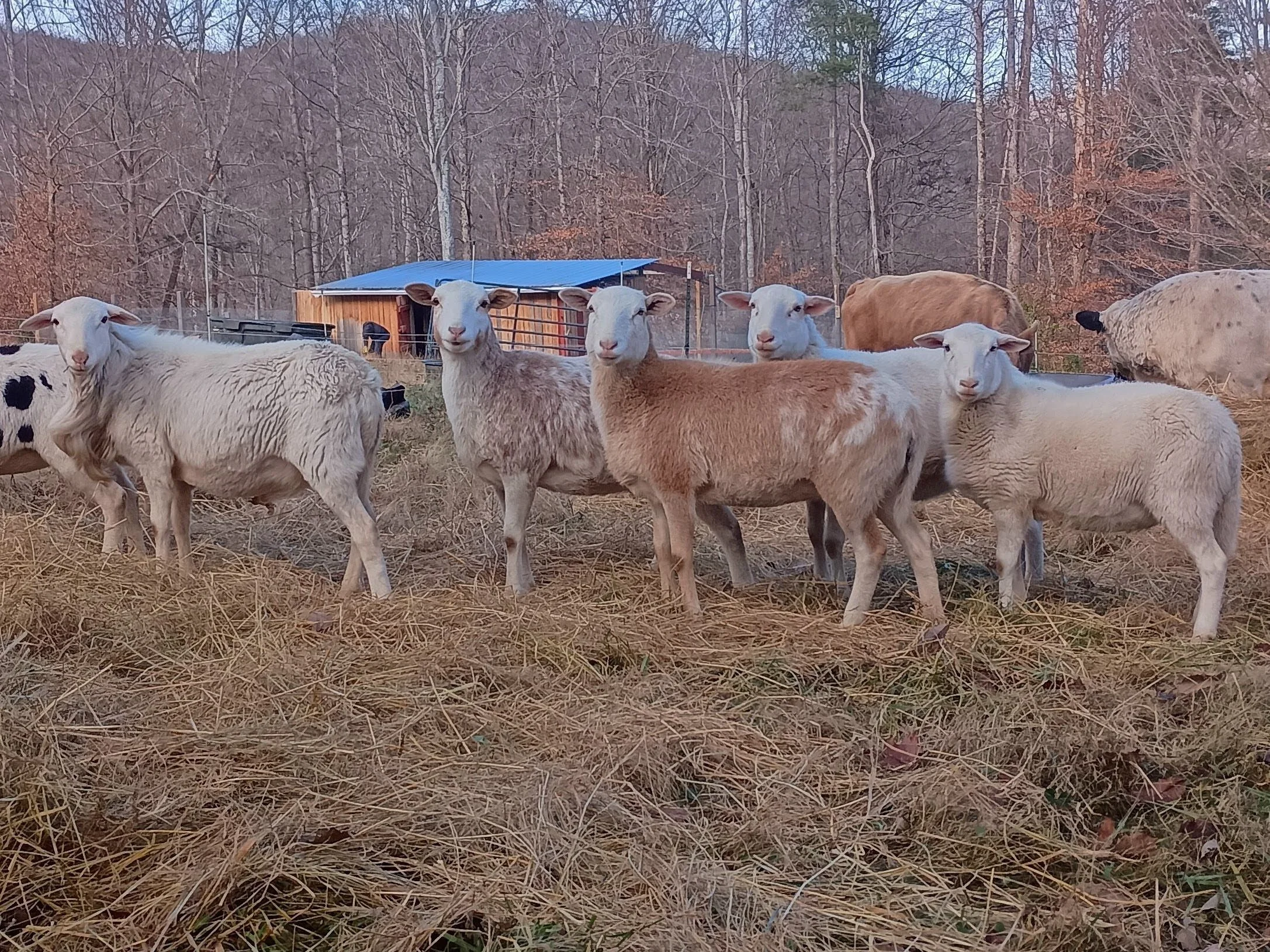
Katahdin and St. Croix cross Sheep
Hair Sheep:
Naturally more parasite resistant
No shearing
High Fertility
Adaptable
Hardy
Resilient
Adorable
Delicious
St. Croix sheep are a breed of hair sheep that were originally created by crossing with wool sheep to improve carcass quality. Katahdin were further developed in the 1950’s through the 1970’s from St. Croix and a variety of wool sheep.
Hair sheep have high parasite resistance and climate adaptability compared to wool sheep, and they do very well in our area. They also are good mothers with high fertility, and less likely to be seasonal breeders. Katahdins are known for being good browsers that will eat brushy forage, even the thorny stuff, and are a good substitute for goats for those trying to reduce multiflora rosa and wild blackberry canes in their pasture. When rotationally grazed with cattle, they help to quickly improve pasture.
Our ewes are mainly Katahdin with some St. Croix and probably a little bit of Dorper mixed in. Our current ram, “Rama-Lama-Ding-Dong”, is a purebred St. Croix. At this time, we are not offering sheep for sale as we are focusing on building our flock, but we intend to in the future!
To learn more about Katahdin sheep, click here.
About Our Sheep
Diet
At Bear Mountain Farm, we prioritize a biologically appropriate diet to ensure health. Our combined sheep and cattle flerd is rotated through 20 acres of lush, biodiverse pasture year-round, and supplemented with unsprayed hay and silage in the winter. We give a daily ration of alfalfa pellets and a tiny amount of fermented organic grain to reinforce bucket training and friendly behavior. This is top dressed with kelp, humates, and garlic to ensure they receive essential nutrients, Additionally, their daily treat offers the opportunity to easily administer herbal medicine by mixing it into their food when necessary. Our flerd is also given access to free choice salt and cafeteria style minerals from FCE.
Holistic Practices
Hair sheep are naturally resilient and hardy, and by starting with parasite resistant genetics and an appropriate diet, we are able to rely on rotational grazing and mineralization to minimize health issues. Ultra high density rotational grazing is a key component of our regenerative farm. Our cattle/sheep flerd is moved to fresh pasture every day, and usually several times a day. Carefully managed grazing improves pasture, increasing nutritional value, biodiversity, water retention, and resilience. Rotational grazing also reduces disease, flies, and parasite load. When the need arises, we use Dr. Paul’s organic herbal products for livestock or Land of Havilah herbal dewormers.
Natural Rearing
Bear Mountain Farm lambs will be born out in the pasture in April/May this year. We are still figuring out exactly how that will look right now! We do know that they will be born a low-stress environment, and live side-by-side with the rest of the flerd. Our ram will be separated post birth in order to prevent immediate rebreeding, so that we can control our lambing season. For now, we plan to wether all males and keep all females (except for culls) in order to increase our flock size. We intend to introduce a new ram every year or every other year.
Next Availabilty:
2027
For now, we are building our flock. Check back in the future!
Or visit our “waitlist” page to be put on a waitlist and contacted when we have availability!